
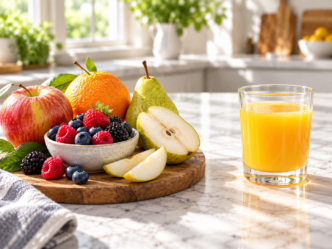
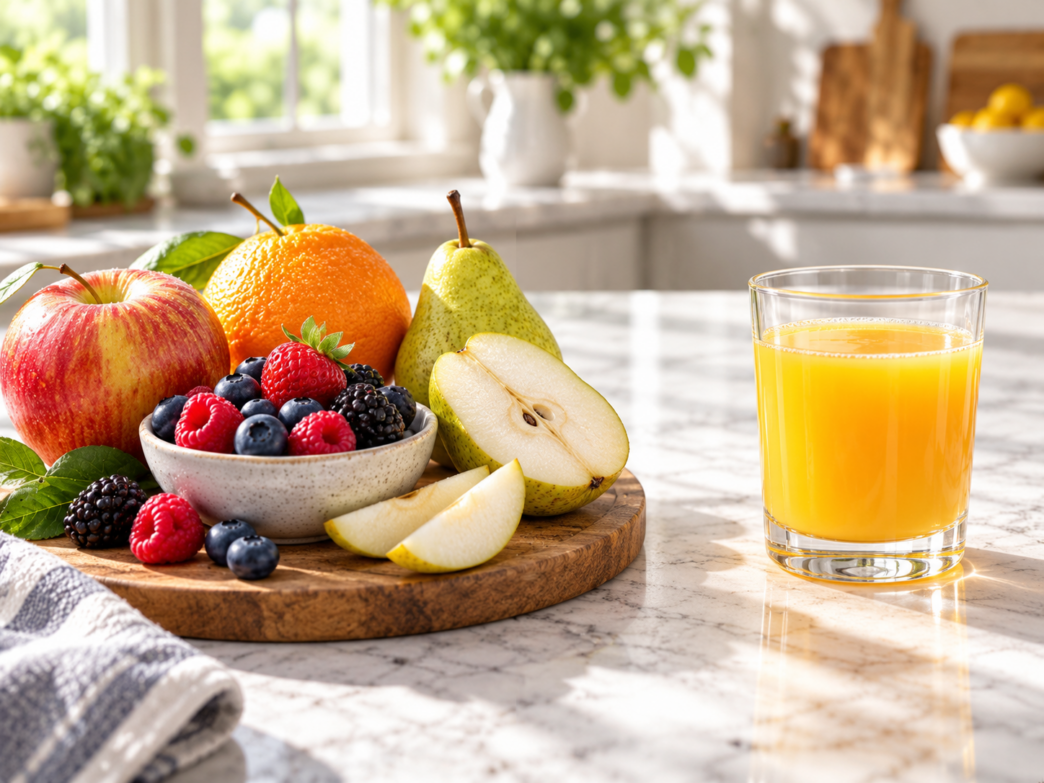
An orange and a glass of orange juice may come from the same fruit.
But your body doesn’t necessarily experience them in exactly the same way.
Whole fruit retains its natural structure and fiber. Juice removes much of that fiber and makes it possible to consume the equivalent of several pieces of fruit very quickly.
That doesn’t mean 100% fruit juice is automatically “bad.”
Current U.S. guidance allows 100% fruit juice to fit into a healthy eating pattern, but recommends consuming it in limited portions and generally choosing whole fruit more often. CDC guidance specifically notes that whole fruit contains fiber that helps with fullness, while many fruit juices contain little to no fiber. CDC
So what actually changes when fruit becomes juice?
Whole Fruit Keeps More of Its Fiber
Fiber is probably the most important nutritional difference between eating fruit and drinking its juice.
When you eat an apple, pear, orange, berries, or other whole fruit, you’re consuming the fruit’s natural carbohydrates along with fiber.
Traditional juicing removes much of the solid material where that fiber is found.
CDC explains that whole fruits are preferable partly because their fiber can help you feel fuller, while many juices contain little or no fiber. CDC
Fiber also supports digestive health and can slow digestion.
That means an orange isn’t simply orange juice in solid form.
The structure of the food matters.
Juice Is Much Easier to Consume Quickly
Think about eating three oranges.
You have to peel them.
Chew them.
Swallow them.
And by the second or third orange, you may already feel satisfied.
Now imagine drinking a glass of orange juice.
You could finish it in a minute without thinking much about it.
CDC notes that making approximately one cup of orange juice can require several oranges, making it easy to consume more fruit-derived sugar at one time than you might if you were eating the whole fruit. CDC
This is one reason portion size matters with juice.
Liquid calories are generally much easier to consume rapidly than solid food.
Whole Fruit May Keep You Satisfied Longer
One apple takes time to eat.
Apple juice is much easier to drink.
Because whole fruit retains fiber and requires chewing, it generally provides more physical volume and tends to be more satisfying.
CDC specifically recommends choosing whole fruits over fruit juices because fiber helps with fullness. CDC
This can be useful when building snacks.
Instead of having a glass of juice alone, you might have an apple with a small handful of nuts or an orange alongside plain yogurt.
You’re getting the fruit plus additional protein or fat, which may create a more substantial snack.
What Happens to the Sugar?
Fruit naturally contains sugars.
That doesn’t make whole fruit equivalent to soda or candy.
Whole fruit delivers its natural sugars inside a food containing water, fiber, vitamins, minerals, and other plant compounds.
With juice, the natural sugars remain, but much of the fiber is removed.
CDC’s diabetes nutrition guidance specifically recommends eating whole fruit instead of drinking juice, noting that juice can make it easier to consume a larger amount of sugar at once while missing much of the fiber. CDC
That doesn’t mean natural sugar in 100% juice suddenly becomes “added sugar.”
It means the physical form and concentration are different.
Does Juice Raise Blood Sugar Faster?
For people paying attention to blood glucose, the difference in food structure can matter.
Fiber slows digestion. Removing much of that fiber means the carbohydrate in juice can generally be absorbed more rapidly than carbohydrate from the intact whole fruit.
CDC advises combining carbohydrate foods with protein and emphasizes whole fruit rather than juice when discussing healthier carbohydrate choices. CDC
People with diabetes don’t necessarily need to avoid all fruit or all 100% juice.
But portions, medications, total carbohydrate intake, and individual glucose responses matter.
Someone managing diabetes should follow the eating plan recommended by their healthcare professional or registered dietitian.
Is 100% Fruit Juice Healthy?
This is where the conversation needs some nuance.
There is a significant difference between 100% fruit juice and beverages marketed as fruit drinks, fruit punches, cocktails, or fruit-flavored beverages.
The Dietary Guidelines note that 100% fruit juice without added sugar can be part of a healthy dietary pattern. However, it contains less dietary fiber than whole fruit. Dietary Guidelines
Current U.S. dietary guidance also recommends consuming 100% fruit juice in limited portions rather than making it a primary everyday beverage. CDC
So you don’t need to think:
“Juice is unhealthy and I must never drink it.”
A more useful approach is:
“Whole fruit will usually be my first choice, while 100% juice can occasionally fit in an appropriate portion.”
Fruit Drinks Are a Different Story
A bottle with pictures of oranges, berries, or tropical fruit on the label isn’t necessarily 100% juice.
Some beverages contain relatively little actual fruit juice and may include added sugars.
CDC distinguishes 100% juice from fruit drinks and fruit-flavored beverages containing added sugar. CDC
Check the package.
Look for wording such as 100% juice rather than assuming that every colorful fruit beverage is nutritionally equivalent.
The Nutrition Facts label can also show whether added sugars are present.
Is Fresh-Squeezed Juice Better?
Freshly squeezed juice can taste excellent and may provide vitamins and other nutrients.
But squeezing it yourself doesn’t restore the fiber that gets left behind.
A homemade glass of orange juice is still different from eating the oranges themselves.
The important comparison isn’t simply:
Store-bought vs. homemade.
It’s also:
Juiced fruit vs. intact fruit.
Whole fruit still has the advantage when your priorities include fiber and fullness.
What About Smoothies?
Smoothies are somewhat different from traditional juice.
When fruit is blended rather than juiced, much of the whole fruit—including its fiber—can remain in the drink.
However, portion size still matters.
It’s easy to place a banana, berries, mango, several other fruits, juice, sweetened yogurt, and honey into a blender and create a very large drink.
A balanced smoothie might instead combine whole fruit with a protein source such as plain Greek yogurt or milk, along with ingredients such as oats or nut butter.
Blending doesn’t automatically make something healthier or less healthy.
What goes into the blender matters.
Is Whole Fruit Good If You’re Trying to Manage Weight?
Whole fruit can fit comfortably into a healthy eating pattern.
CDC notes that fruits and vegetables provide water and fiber, which can add volume and help people feel full while often providing fewer calories than more calorie-dense foods. CDC
The key concept is substitution.
Adding large amounts of fruit on top of everything you’re already eating isn’t necessarily the same as replacing a more calorie-dense snack with fruit.
For example, an apple might replace cookies at an afternoon snack.
Berries might replace part of the sugary toppings in a breakfast.
Fruit can add nutrition while making meals more satisfying.
Fresh, Frozen, Canned, or Dried?
Whole fruit doesn’t need to be fresh to count.
Fresh, frozen, canned, and dried fruits can all fit into a nutritious diet.
The older Dietary Guidelines explicitly recognized fresh, canned, frozen, and dried forms as whole fruit. CDC
For canned fruit, choosing varieties packed in water or 100% juice rather than heavy syrup can help reduce added sugar.
With dried fruit, remember that removing water makes the portion much smaller and more concentrated.
A small handful of raisins is very different in volume from a large bowl of grapes.
Again, portion awareness matters.
What Should You Drink Instead?
For everyday hydration, water is still the simplest choice.
The 2025–2030 Dietary Guidelines recommend water and unsweetened beverages as primary drink options while advising limited portions of 100% fruit juice. CDC
Plain sparkling water, unsweetened tea, and unsweetened coffee may also work for many adults.
If you enjoy juice but routinely drink large glasses, you don’t necessarily need to eliminate it overnight.
Try reducing the serving size.
You could also dilute a small amount of 100% juice with sparkling or still water. CDC includes diluted 100% fruit juice among alternatives to sugary drinks. CDC
An Easy Rule for Everyday Life
Nutrition advice doesn’t need to become another source of anxiety.
When choosing between fruit and juice, think:
Eat your fruit most of the time. Drink juice occasionally and keep the portion reasonable.
Choose an apple instead of apple juice.
Eat an orange rather than automatically pouring orange juice.
Add berries to breakfast.
Keep bananas available for a quick snack.
If you enjoy a small glass of 100% juice, it can still fit.
The goal isn’t dietary perfection.
It’s making the more nutritious option easier to choose most of the time.
The Bottom Line
Whole fruit and 100% fruit juice can both provide vitamins, minerals, and naturally occurring sugars.
But they aren’t nutritionally identical.
Whole fruit retains more fiber, generally requires more time to eat, and tends to be more filling.
Juice contains less fiber and makes it easier to consume the equivalent of several pieces of fruit quickly.
That’s why current health guidance generally recommends choosing whole fruit more often and consuming 100% fruit juice in limited portions. CDC
There’s no need to fear fruit.
And there’s no need to treat a small glass of 100% juice as a dietary disaster.
Just remember that when you have the choice, the whole apple, orange, pear, or bowl of berries usually gives you something juice can’t fully replace:
the fiber and structure of the original fruit.
Frequently Asked Questions
Is eating fruit better than drinking fruit juice?
For everyday eating, whole fruit is generally preferred because it retains fiber and tends to be more filling. CDC specifically recommends choosing whole fruits over fruit juices for this reason. CDC
Does 100% fruit juice contain added sugar?
Pure 100% fruit juice doesn’t necessarily contain added sugar; the sugar naturally present in the fruit remains in the juice. However, fruit drinks, punches, and fruit-flavored beverages may contain added sugars, so check the label. CDC
Can 100% juice be part of a healthy diet?
Yes. Current U.S. guidance allows 100% fruit juice as part of a healthy dietary pattern but recommends consuming it in limited portions and emphasizing whole fruit. CDC
Is fresh juice better than packaged juice?
Fresh juice may differ in processing and taste, but juicing still removes much of the fiber found in intact fruit. Whole fruit generally remains the better choice when fiber and fullness are priorities.
Are smoothies the same as juice?
Not necessarily. Blending usually retains more of the whole fruit’s fiber than traditional juicing, although smoothie portions and added ingredients can make a significant difference nutritionally.
Should people with diabetes avoid fruit?
Not automatically. Whole fruit can fit into many diabetes eating plans. Individual carbohydrate needs, portions, medications, and glucose responses vary, so personalized guidance is appropriate.
Health Living Note
Fruit doesn’t need to be complicated.
Eat the apple. Peel the orange. Add berries to breakfast. Reach for whole fruit more often, and treat juice as a beverage to enjoy in sensible portions rather than a replacement for every serving of fruit.
Small distinctions like this can make everyday nutrition much easier to understand.